
The Feeling of a Local Indian Store
Step into any authentic Indian home décor store, and you’re immediately surrounded by something you can’t quite name but definitely feel. The smell of natural wood mingles with the faint scent of incense. Your fingers run across hand-carved surfaces that tell stories through their gentle imperfections—a slight unevenness that reminds you these pieces were shaped by human hands, not machines.
The furniture here doesn’t try to be perfect. That wooden chair might have a grain that runs in an unexpected direction. The table might have a tiny chip that somehow makes it more beautiful, not less. The brass figurines catch light differently because each one was hammered into shape individually. This isn’t a flaw—it’s proof of authenticity.
These stores feel alive in a way that showrooms never do. They’re not just selling products; they’re sharing a way of life. Every piece carries the weight of tradition, the skill of generations, and the quiet pride of makers who learned their craft from their fathers, who learned it from theirs.
Indian craftsmanship isn’t just about making things. It’s about making things that matter, that last, that carry meaning from one home to another. When you buy a piece of handmade Indian furniture or décor, you’re not just buying an object—you’re buying a piece of someone’s story.

Atmanirbhar Bharat – Where the Story Truly Begins
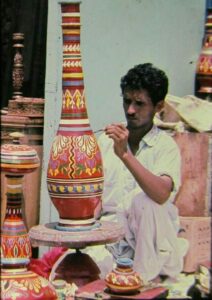
Aatmanirbhar Bharat isn’t really about policies or government programs, though those exist. At its heart, it’s about believing in what we already have—our hands, our skills, our traditions that have survived centuries.
Think of the carpenter in Kerala who can shape wood without a single power tool, or the metalworker in Rajasthan who creates intricate designs using techniques his grandfather taught him. These aren’t outdated methods—they’re living traditions. Aatmanirbhar Bharat is about recognizing that these makers don’t need to change what they do; they need the world to discover what they’ve always done.
It’s about self-belief that runs deeper than economics. When a village potter shapes clay into something beautiful, they’re not just making a living—they’re keeping alive a piece of Indian culture. When their work reaches homes across the world, it’s not just export; it’s sharing who we are.
The real strength of Aatmanirbhar Bharat lies in empowering these local makers to stand strong on the global stage. Not by asking them to compromise their authenticity, but by helping the world recognize the value of what they create. When local skills meet global appreciation, everyone wins.

When Home Is Far Away
Living away from India does something to you that’s hard to explain to someone who’s never experienced it. You miss your family, of course. You miss the food, the festivals, the familiar chaos of Indian streets. But there’s something else you miss—something more subtle but equally deep.
You miss the feeling of being in an Indian home.
It’s not just about the people in that home. It’s about the brass lamp that cast warm shadows on the wall. The carved wooden mirror that reflected not just your face but generations of family history. The cotton curtains that moved gently with the evening breeze. The small temple in the corner with its familiar figurines.
When you’re living in London or New York or Dubai, you can recreate the recipes and celebrate the festivals. But recreating that feeling of an Indian home? That’s much harder.
Your apartment might be beautiful. It might be modern and clean and perfectly designed. But it doesn’t feel like home in the way you remember home feeling. There’s an emotional gap between your memory and your reality, and that gap can make even the most successful life abroad feel somehow incomplete.
The Problem: Wanting Local, But Not Finding It
Finding authentic Indian home décor and furniture outside India is like looking for a needle in a haystack—except the haystack is full of things that look like needles but aren’t quite right.
Walk into any furniture store in a major global city, and you might find an “Indian-style” section. But what you’ll find there often feels like Indian culture as seen through someone else’s eyes. The colors are too bright, the designs too obvious, the execution too mechanical. These pieces shout “exotic” instead of whispering “authentic.”
Then there are the mass-produced items that technically come from India but feel nothing like the handmade pieces you remember. They’re made in factories, designed for global markets, stripped of the imperfections and character that made the originals special. They look Indian, but they don’t feel Indian.
And when you do find something truly authentic? The prices often make you wonder if the item is made of gold instead of wood. Import costs, middleman markups, and the rarity of genuine pieces combine to make authentic Indian décor and furniture a luxury that many can’t afford.
So you compromise. You buy something that’s “close enough.” You tell yourself it’s fine, that it doesn’t really matter. But every time you look at it, you’re reminded of what you couldn’t find, what you had to settle for.

The Quiet Gap Between Artisans and Global Homes
On one side, you have Master Craftsman Ravi in Jodhpur, who can create a wooden screen so intricate it looks like lace made of wood. His workshop is filled with pieces that would make design magazines weep with joy. He has the skill, the tradition, the passion, and the authenticity that global markets crave.
On the other side, you have Priya, living in Toronto, scrolling through furniture websites late at night, looking for something—anything—that might make her apartment feel more like the home she left behind in Mumbai.
Ravi has exactly what Priya wants. Priya wants exactly what Ravi makes. But they exist in parallel universes that never intersect.
Ravi’s work rarely travels beyond his state, let alone his country. He doesn’t have the connections, the logistics network, or the global reach to get his pieces to international markets. His talent is local, but his potential is global—and that potential remains untapped.
This isn’t just Ravi’s story. Across India, thousands of skilled artisans create beautiful, authentic pieces that could transform homes worldwide. But talent without reach is like having a conversation where only one person can speak.
The phrase “local to global” gets thrown around a lot these days, but for most artisans, it remains a distant dream rather than a practical reality.
The Bridge: Where Homenetik Comes In
This is where Homenetik saw an opportunity that was also a responsibility. Not an opportunity to create something new, but to connect what already existed—authentic Indian craftsmanship on one side, global homes hungry for authenticity on the other.
I’ve always believed that the best solutions come from simply paying attention to what’s missing. When we looked at the global market for Indian home décor and furniture, we saw the gap clearly. Beautiful work was being created every day in workshops across India, but it was staying local not by choice, but by circumstance.
Homenetik doesn’t try to be another marketplace. We’re more like a bridge—connecting local Indian artisans and their authentic créations with homes around the world. But bridges aren’t just about creating connections; they’re about preserving what travels across them.
Every piece that travels through Homenetik carries with it the story of its maker, the tradition of its creation, and the authenticity of its origin. We don’t ask artisans to change their methods or modernize their designs. Instead, we help the world understand why these methods and designs are valuable exactly as they are.
When Master Craftsman Ravi’s wooden screen finally reaches Priya’s apartment in Toronto, it’s not just furniture crossing borders—it’s culture finding its way home.


Homes Carry Culture
A home is never just a space. It’s a reflection of who you are, where you come from, and what matters to you. The things you choose to surround yourself with tell your story even when you’re not there to tell it yourself.
For Indians living abroad, this becomes even more meaningful. That brass figurine on the shelf isn’t just decoration—it’s a connection to the temple visits of childhood. The carved wooden box on the dresser doesn’t just hold jewelry—it holds memories of shopping in local markets with your mother.
These pieces carry emotional weight that goes far beyond their design value. They’re anchors that keep you connected to your roots even when those roots are thousands of miles away.
But here’s what’s interesting: this desire for authenticity and meaning isn’t limited to Indian homes. People everywhere are tired of mass-produced furniture that could be found in any home in any city. They want pieces with stories, items with character, décor that means something.
When a non-Indian family chooses a handmade Indian coffee table for their living room, they’re not just buying furniture—they’re buying into a story, a tradition, a way of seeing beauty that might be different from their own but speaks to something universal.

Looking Ahead: The Future of Local to Global
The future I see isn’t about Indian crafts conquering global markets. It’s about Indian crafts finding their rightful place in global homes—with dignity, authenticity, and respect.
In this future, local and global don’t feel like opposites. A hand-carved mirror made in a Udaipur workshop sits comfortably in a London bedroom. A brass lamp crafted using centuries-old techniques illuminates a modern apartment in New York. The local becomes global not by losing its identity, but by sharing it.
Artisans like Master Craftsman Ravi don’t just survive—they thrive. Their skills are valued not as curiosities from the past, but as treasures for the present. The global market doesn’t just tolerate their traditional methods; it celebrates them.
This is what Aatmanirbhar Bharat looks like when it’s lived rather than just discussed. It’s about Indian craft standing strong on the world stage, carrying with it all the tradition, skill, and authenticity that makes it special.
Every time someone chooses a handmade Indian piece for their home instead of a mass-produced alternative, they’re making a vote for this future. They’re saying that authenticity matters, that tradition has value, that the human touch is worth preserving.
Closing Thought
There’s something beautiful about honest work traveling honestly to places where it’s truly wanted and appreciated.
When that wooden screen finally makes its journey from Master Craftsman Ravi’s workshop in Jodhpur to Priya’s apartment in Toronto, it’s carrying more than just Indian craftsmanship—it’s carrying the hope that local and global can meet without either losing what makes them special.
The world is hungry for authentic, meaningful pieces that tell stories and carry culture. India has been creating these pieces for centuries. Now, finally, they’re finding each other.
When local meets global honestly, something magical happens. Homes become more meaningful, artisans become more valued, and traditions become living parts of the present instead of relics from the past. This isn’t just about furniture and décor—it’s about a world where authenticity finds its way home, no matter how far it has to travel.


Summary
This blog explores the journey of Indian craftsmanship—from local stores and village workshops to homes across the world. It begins with the idea of Aatmanirbhar Bharat, not as a policy, but as a belief in local skills, people, and traditions. While global demand for authentic Indian home décor and furniture continues to grow, access remains limited often replaced by inauthentic or overpriced alternatives.
The story highlights the quiet gap between local artisans and global homes, where talent exists but reach does not. It then introduces Homenetik as a natural bridge—connecting locally made Indian décor and furniture to global spaces without losing authenticity or cultural meaning.
At its heart, the blog is about homes that carry culture, products that carry stories, and a future where local craftsmanship finds its rightful place on the global stage. When local meets global honestly, everyone benefits—artisans, homes, and the traditions that live within them.
You can connect with us on our social media handles:
Instagram https://www.instagram.com/homenetik_spaces?igsh=MXVqcXlmNnNsbDBsMw==
YouTube : https://youtube.com/@homenetik?si=NpOMcqLwPiyxxUYY
Twitter : homenetik@gmail.com
Linkdin : https://www.linkedin.com/in/homenetik-decor-and-interior-822297378
Tags
#Homedecor #Interior #local to global #furniture #aatmanirbharat #traditional #homenetik




Leave A Comment